Universe 2 vs. New Dimensions II
Hello, and welcome back to The Hinterlands. Today I’m talking about a couple of Science Fiction Original Anthologies from 1972. These areshort fiction collections composed of original material rather than collections of previously published work. As I write this I’m working on both a longer form piece about Damon Knight’s Orbit series, which played a significant role in popularizing the Original Anthology– and so between that and having started both of these collections for the Award Winning Short Stories of 1973 post, this seemed like a natural extension of what I’ve already been reading, writing, and thinking about.
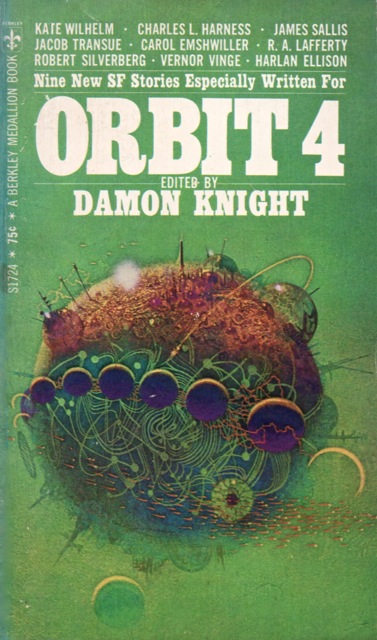
My Orbit piece (and the next blog post) may not be till October at this rate, but good things come to those who wait, or something like that
Historically as a reader I had very little interest in short fiction anthologies collecting multiple authors, preferring single author collections and especially “definitive” ones, best ofs, complete stories of, etc. Over the last year that’s changed, and I’ve come to love collecting anthologies, original anthologies being one of my favourite types to find in the wild, alongside “Best of the Year” collections (preferably from the 60’s and 70’s), Award anthologies, and Best of’s from various Magazines (F&SF, Galaxy, etc). Why? Well original anthologies are primary source documents, original publication objects unmediated by anthologists making curation choices that may be driven by any number of factors. Like an issue of F&SF, Galaxy, etc they are the original source of publication for the stories within, without going through a secondary curation process. If you can collect all of an original anthology series, you’ll have every story every published in that series! But unlike the magazines, the total number of publications to collect is measured in the 1 to 2 dozen range rather than the hundreds.
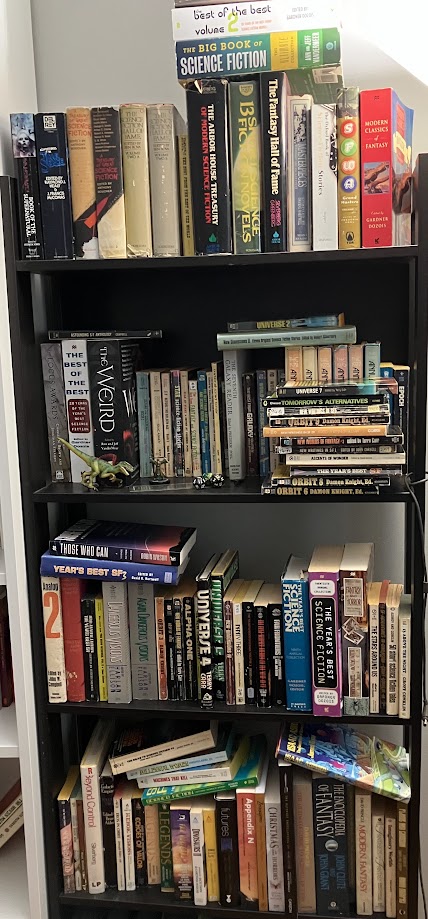
My current anthology collection, ever growing.
So why review these two specific anthologies? Well, as mentioned above, I pulled stories from both of these volumes to read for a prior blog post. I had decided to read all the volumes I started for that blog post in full anyway, and things I’m going to do anyway are always the best material for blog posts.
Worth thinking about in the context of my upcoming Orbit blog post, these two series are leaders in the cohort of original anthologies in the model of Orbit that ended up supplanting Orbit, rising in prestige and racking up award nominations as Orbit declined in the latter half of the 70s. In 1972 both New Dimensions and Universe were on their second edition and contained many of the same authors, providing a good opportunity to compare and contrast the approaches of the editors, and think about what differentiates these publications from each other, from the magazines of the time, and from Orbit. Most importantly, and you’ve all been clamouring for I will determine once and for all which is the superior of the two volumes.
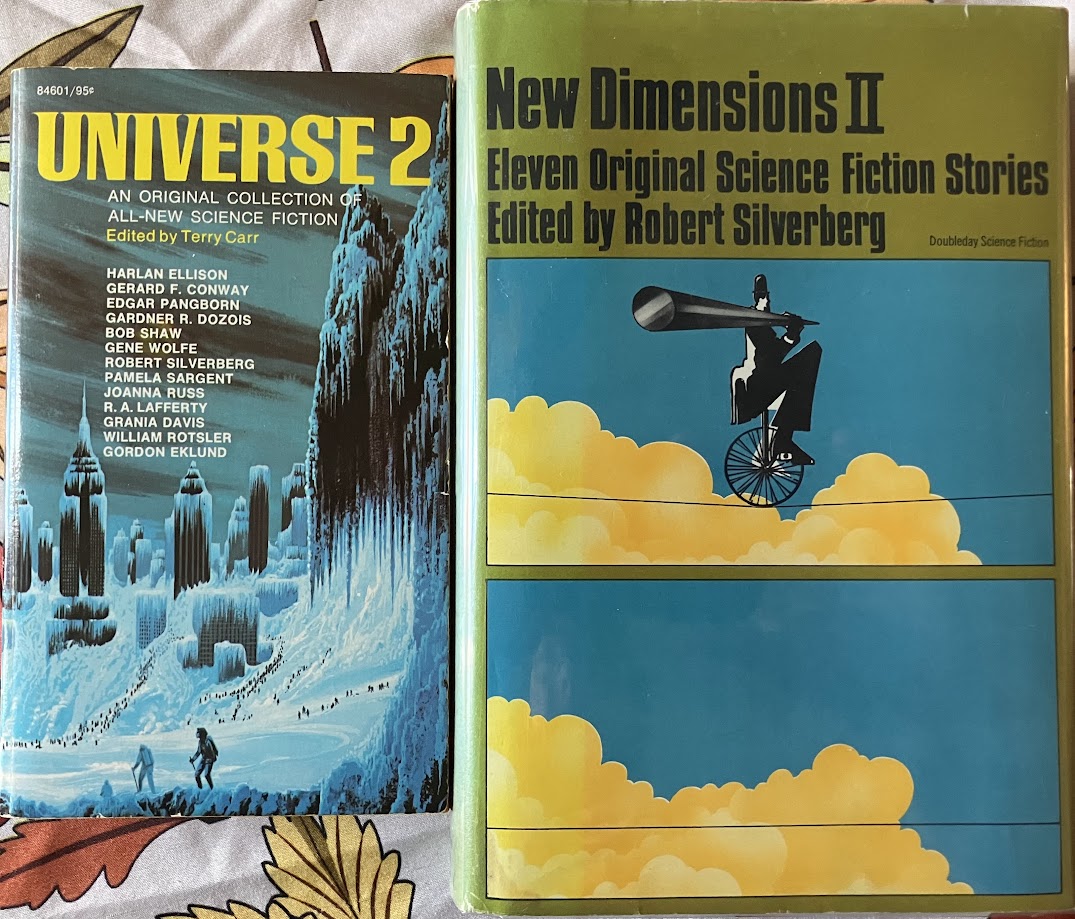
it's the books! the ones we're talking about!
Universe
Universe was one of the most successful original anthology series, be it in terms of longevity (ran from 1971 - 1987), awards success, or critical reputation and legacy (the Science Fiction Encyclopedia calls it “arguably the best of all the original anthology series”) It was the flagship anthology series of legendary SF editor Terry Carr, who shepherded it through multiple different publishers until it found a permanent home at Doubleday from volume 6 until the end of the series.
As mentioned above, Terry Carr was one of the most important science fiction editors of the 20th century, as well as being a prolific fan writer and a less prolific fiction writer. In addition to the Universe series he edited a number of different “Best SF of the year” series and theme anthologies, and maybe his greatest achievement came in the 80s when he edited a series of debut novels for Ace, an unbelievable run highlighted by William Gibson’s Neuromancer but also including debuts by Kim Stanley Robinson, Michael Swanwick, and Howard Waldrop.
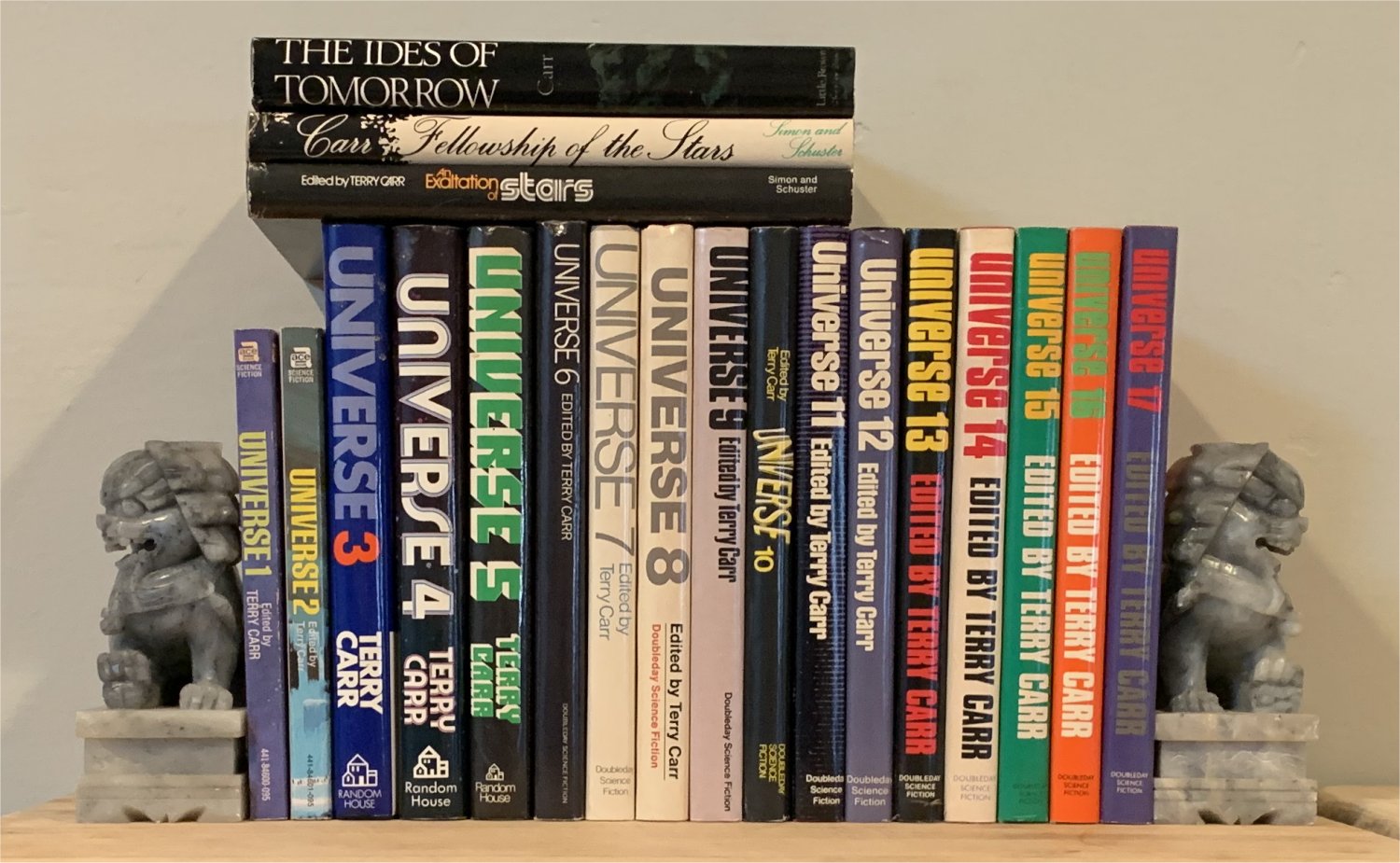
credit to sfadb's always useful Anthology section for this photo
New Dimensions
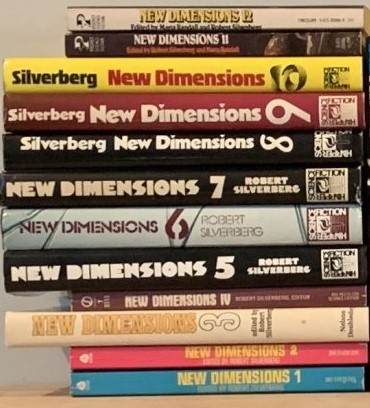
Like Universe, New Dimensions was well respected critically, but it was less successful commercially. It ran from 1971 - 1981 and went through four publishers across its 12 volumes. It had 4 Hugo/Nebula winners and many more nominees, while being edited by Robert Silverberg for the entire run, while Marta Randall co-edited volumes 11 and 12.
Robert Silverberg was one of the most prolific science fiction writers of the 20th century. Writer of over 100 SF novels (and over 200 erotic novels under a pen name), the guy is legendary, and if you spend any time at all reading about science fiction in the 60s and 70s you’ll quickly discover he is omnipresent. In addition to his enormous fiction output, he was also a prolific editor, particularly when it came to theme anthologies. His peak output coincided with the peak of the New Wave of SF, 1967-1976, and his deserved reputation as one of the literary giants of Science Fiction is enhanced by his editorship of New Dimensions which, very much in the mold of Orbit, promoted experimental stories and new writers, fighting to represent science fiction as a legitimate field of literature worthy of study, analysis, and cultural prominence.
credit to sfadb
The Stories
I’m going to start by doing some direct comparisons - there are four authors who appear in both anthologies, so the easiest part of my job will be comparing which collection got the better story by that author. Let’s get to it:
R.A. Lafferty
Lafferty was discussed briefly in my blog post about the Big Book of Science Fiction, but as a refresher he was a very prolific short fiction writer in the 60’s and 70’s, known for his extremely idiosyncratic style as well as his satiric wit. His story in New Dimensions II is Eurema’s Dam, which I discussed in my Award nominees of 1972 blogpost. It’s a good story, but not outstanding.
Lafferty’s story in Universe 2 is A Special Condition in Summit City, in which scientists propose that human communication is primarily telepathy based, and that words actually convey only a small percentage of information. To test this theory, they broadcast a signal that disables telepathy within a city. Chaos ensues. The premise of linguistic short-circuiting is an excellent device for showcasing Lafferty’s unique style. The way that he depicts the total breakdown of language in his prose is brilliant and very funny. Sentences terminate ineffectually, falling just short of creating meaning, non-sequiturs flash to life and then fade away cryptically, all hilariously communicating that the characters are imprisoned by their inability to make themselves understood or to understand others. Lafferty at his best is playful, a delight to read while still making you think, and this story is a great example of exactly that.
Edge to Universe
Joanna Russ
Joanna Russ was also discussed briefly in the BBoSF blog post, Russ emerged in the New Wave of the 60’s, was one of the great feminist science fiction writers, and is on the short list of the best writers to work in the genre ever. This one is cheating a bit, because Russ’s story in Universe 2 (Useful Phrases for the Tourist) is really more of a clever joke than a proper story. It’s a clever joke that I like, but there’s not enough substance for it to compete with Nobody’s Home, her story from New Dimensions II. Nobody’s Home is a story of our utopian science fiction future where everyone is a pansexual polyamorous genius Katherine Hepburn-type, and the small tragedy it would be to be normal in that future. Russ rattles off rapid-fire intellectual dialogue that successfully makes the reader feel like the outcast of the story, a normal intellect living among the shining people (or, one suspects, maybe what it was like for a normal intellect trying to keep up with dinner party conversation between Russ and Samuel R. Delany). What makes the story a winner for me is the way this perfectly brilliant, altrustic, and “evolved” main character ultimately can’t make herself care about the plight of the isolated and abandoned woman who has been assigned by the government to her polycule for more than a few minutes before shrugging her shoulders and returning to her life of comfort, making plans to have the woman sent away in the morning, because what else could they do?
Edge to New Dimensions
Gardner Dozois
Gardner Dozois was one of the most important editors of SF, editing Asimov’s Science Fiction Magazine from 1986 to 2004 and his “Year’s Best Science Fiction” series which ran from 1984 to 2019 (the final volume was published posthumously), outlasting the similar series by Wollheim, Carr, etc to become the de-facto Annual SF roundup for 3 decades. Dozois emerged as a writer at the tail-end of the 60’s under the editorship of Damon Knight at Orbit and racked up a handful of award nominations, eventually winning back to back nebulas for best short story in 1984 and 1985.
These two stories were my first exposure to Dozois’s fiction and Wow! I hated both of these stories! The Man Who Waved Hello in Universe 2 is a story of the miserable state of life in a dystopian authoritarian future-state. It’s fine for the first 90% but ultimately the worse of the two stories because the ending is an eye-rolling “naughty” punchline. King’s Harvest in New Dimensions 2 doesn’t have the surprise ending but is instead misery from start to finish, an environmental collapse story about an old man wandering around in an abandoned city suffering and feeling bad about how we humans fucked it all up. If there were a lot of stories like this running around in the 70s I can understand some of the contemporary reviewer complaints I’ve read about how doom and gloom stories of this era could be.
Edge to nobody!
Gordon Eklund
Eklund is the first of these writers I had to look up to write this biography because I knew next to nothing about him, just that he was a 70’s SF writer whose name I’ve come across from time to time. A quick perusal of his SF Encyclopedia page reports that he kind of came and went, writing a few novels of middling interest in the 70s, co-authoring a nebula winning novelette with Gregory Benford, working on a lot of “co-authored” E.E. Smith space operas in which he captures the pulp writer’s tone expertly (his background prior to going pro was in fan fiction), and then more or less disappears after the end of the decade. His stories in both anthologies are interesting but not ground-breaking, and I strongly prefer one to the other: let’s talk about it.
Universe 2 has Stalking the Sun, a story about a family of two husbands and their wife engaging in the pastime of their day: using a time machine to go big game hunting in the dying Earth future. And what prey would be more impressive to put on your wall than the head of the ape men that humans have devolved into? The premise is a little stronger than the execution but I liked this story. At its center is the strange matriarchal relationship dynamic, the origins of which are never explained, which is a strength of the story. Alongside the relationship is the quiet finality of a dying future Earth without any hope, which is simply accepted as inevitable. It creates an effective mood of doomed mystery, which I liked.
In New Dimensions II, Eklund’s White Summer in Memphis is a parable of race relations, where a genetically engineered white super soldier (or possibly he’s an android?) goes into hiding in a black community in a future where integration has failed so conclusively that separate but equal is formalized in the form of a giant wall that separates white and black neighbourhoods. The big idea here is that the cloned soldiers are regarded as subhuman, and Eklund uses the soldier’s position as both white skinned and lower on the racial caste hierarchy than his black neighbours to try and work American racial politics. He’s not really successful but there have certainly been worse attempts to address race in science fiction.
Edge to Universe 2
The Rest of Universe 2
I’m not going to give full bios for all the remaining authors because this blog post is getting a little long in the tooth, and will give the amount of discussion of each story that I feel it merits.
Retroactive by Bob Shaw
Bob Shaw is a Hard SF/Military SF writer I’ve heard good things about but this is the only work of his I’ve read. It’s an interesting story about a human space army trying to colonize a planet where the indigenous inhabitants can travel through time at will. It definitely falls a bit into the “American soldier feels bad about doing war crimes” post-Vietnam bucket (although given Bob Shaw is from Northern Ireland that may be unfair) but I thought it was interesting and liked the ending (although I may not be reading it in the tone it was intended to be taken).
When We Went to See the End of the World by Robert Silverberg
It’s funny to discuss Robert Silverberg the author and Robert Silverberg the editor in the same piece, but Silverberg was a regular in the beginning of the Universe series, appearing in first four volumes. This story was nominated for the nebula for best short story and so I discussed in an earlier blog post. I like it.
Funeral Service by Gerard F. Conway
No idea who Gerard F. Conway is. This story is a little too by the numbers, lays out What The Story Is About too directly to be interesting, not terrible but I’m giving it a pan. Pan I say!
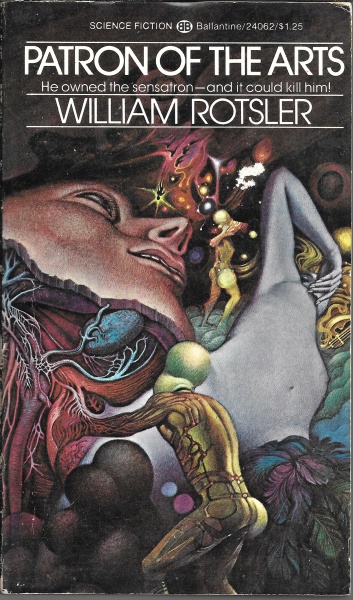
Patron of the Arts by William Rotsler
Another guy I’ve never heard of. This story is about an artist working in a future art form that seems to be some combination of holograms, VR, and sculpture. It’s about the portrayal of women in art and the way a rich artistic patron and a genius artist “see” women. This wouldn’t fly today but it’s not really offensive. It’s kind of charming honestly, this rich guy who basically sets up a situation where he knows his wife will leave him for this great artist but he can’t stop himself because he wants a portrait done of her in “sensovision” or whatever so badly. It’s silly!
Looks like this novelette got expanded into a full novel. I can't say the novelette itself deserves it, but if I see this cover in the wild it's an insta-buy. That is so cool.
On the Downhill Side by Harlan Ellison
Talked about this in my Award Winning Short Stories of 1972 post. I like it, in contention with the Lafferty for best story of Universe 2.
The Other Perceiver by Pamela Sargent
Pamela Sargent is someone I want to learn more about. She had a few books in the Timescape line, edited the Women of Wonder anthology, and eventually won a Nebula for best Novelette in 1993. This story is a goofy satire about a guy with amnesia who is being compelled by a turtle alien to get samples of feces from various women. It’s funny!
My Head’s in a Different Place, Now by Grania Davis
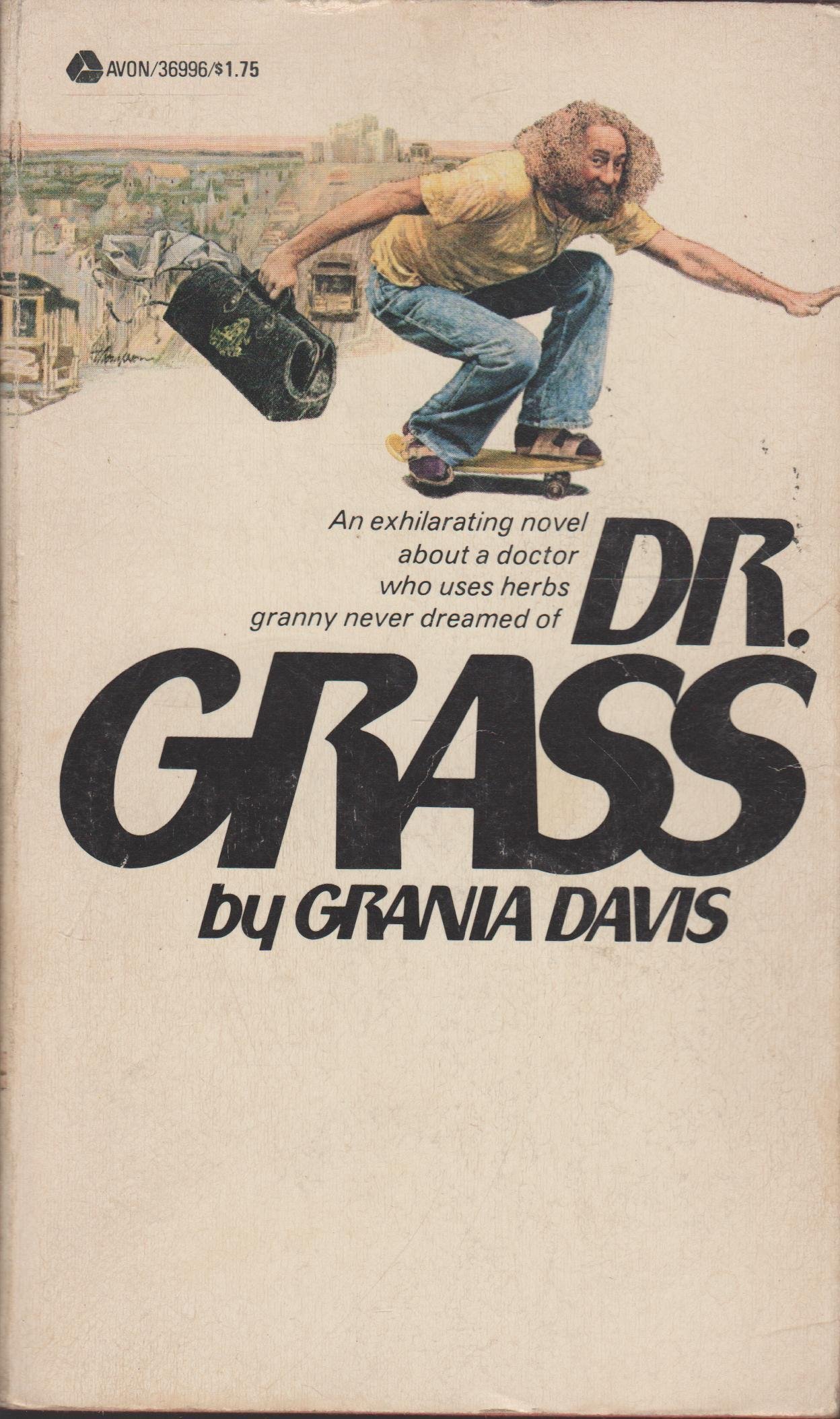
One of the worst pieces of shit I’ve ever read. Hippy-exploitation satire of the lowest order imaginable. I’ll take that Dozois story over this 10 times out of 10 because at least it’s short, this thing goes on forever. Looked up Grania Davis to find out more about who could possibly write this crap and I guess this kind of thing was her bag, man, because her most famous work these days seems to be a novel called Dr. Grass about a former hippie turned doctor. Incredible.
I would be tempted to buy this if I saw it. What a cover...what a title.
The Headless Man by Gene Wolfe
A goofy story by Gene about a guy whose face is embedded in his torso, who wears a mannequin head strapped to his shoulders with an elaborate harness to blend in. Maybe I’m just a die-hard Wolfe pack member but I enjoyed this, it has a bit of a sweet ending.
Tiger Boy by Edgar Pangborn
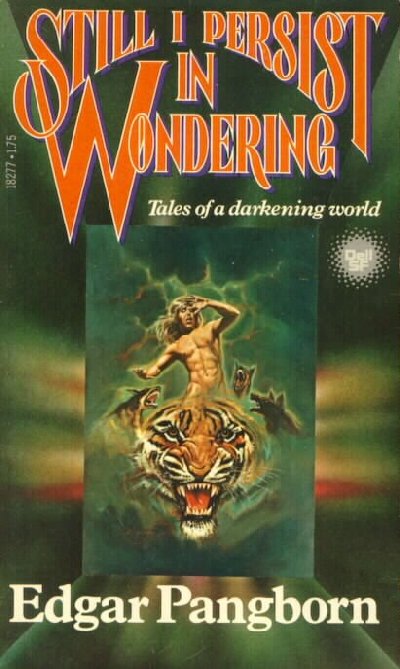
Edgar Pangborn was a major SF novelist of the 60s, and this story is set in the same universe as his popular novel Davy. I haven’t read Davy or any of his other novels but he’s on the list for sure. I found this story to have an interesting setting, a really cool main premise (in the post-post-apocalypse future there’s a boy with a tiger who plays music and people run off to join him and the church wants him killed), but the prose is just too dull for me to really get into it. I will definitely give Davy a chance though, because the setting was very cool.
The cover presents a hint as to why people are running off to join the Tiger Boy...
The Rest of New Dimensions II
Filomena & Greg & Rikki-Tikki & Barlow & the Alien by James Tiptree, Jr.
Tiptree (AKA Alice Sheldon) has been discussed multiple times on the blog by this point but if you don’t know about her, look her up, one of the great science fiction short story writers, fascinating person in general, worth knowing about. I liked this story quite a bit - in some ways it seems like a re-imagining of Stranger in a Strange Land (maybe that’s a stretch?). It also reads like inspiration for The Hitchhikers Guide to the Galaxy, in case that’s of interest to you as it is for me. The story of an alien who comes to Earth and runs into a few very accommodating locals.
Out from Ganymede by Barry N. Malzberg
Malzberg is a fascinating figure of SF who I’m excited to read more of, especially his non-fiction as he was a prolific essayist. This story was a bit disappointing because I didn’t love it, but it’s not bad either. The story of a manned mission to Ganymede being a publicity stunt to distract from the social unrest back on Earth (metaphor for anything?) and the consequences of an encounter with some local Ganymedians. The story is perfectly fine and Malzberg is a good writer but it just felt a little too familiar to me, I feel like this is the kind of thing Ellison had already done better, although the vision of the little (possibly hallucinatory) menacing ganymedians appearing and disappearing at will is good.
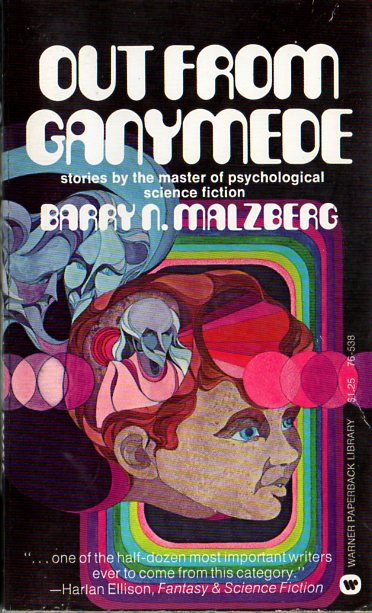
This is a short story collection containing the titular story. You don't come across much Malzberg in the wild. I blame Bookpilled.
No. 2 Plain Tank Auxiliary…etc by Edward Bryant
Edward Bryant was an important short fiction writer in the genre in the 70s and 80s, who won back to back Nebulas for Best Short Story in 1979/1980, along with many other nominations across his career.. I’m interested in reading more of his stuff, but this story, an indirect story of political violence told diagonally didn’t really do much for me. You could pull the “it’s not even science fiction” card, but more importantly I just don’t think it’s very interesting.
Take a Match by Isaac Asimov
As Silverberg says in his introduction, who could possibly need an introduction less than Isaac Asimov? The legendary writer took a long break from writing science fiction in the 60’s before returning full time in the 70s, and this was one of his first stories back. It’s presence in this collection, which is otherwise stuffed to the gills with experimental new wave literary type material is a big win both for the collection and for this story, purely by how different it is from everything else (except maybe the deFord story, but that comes later). In the New Wave era, a lot of the pro-New Wave types criticized the “golden age” by describing those stories as engineers describing scientific concepts for pages with a plot and characters serving mainly as window dressing. If you told me Asimov heard those accusations and then wrote this story to make fun of them I would believe you. It’s a story that revolves around future space travel concepts, developing a mechanism for space flight that uses free hydrogen in space as fuel, then comes up with a speculative situation where hydrogen wouldn’t be available, then comes up with a physics and chemistry based solution to the problem, all of which is explained in detail. (By a horny old man to a beautiful young woman! He’s checking all the “golden age of SF” boxes!)
And it works. Like I said, I think the story benefits by being so different from everything else around it, but the Asimov magic is in action. Despite the fact that describing a theoretical chemistry problem, it’s entertaining, and the setting window dressing he creates keeps the whole thing fun and engaging.
f(x)=(11/15/67) x=her, f(x)!=0 by George Alec Effinger
Effinger is a late New Waver known for novels like When Gravity Fails and A Fire in the Sun. This is the first story I’ve read by him, and I think it went over my head. It’s a metaphor for something that I’m not putting the dots on frankly I don’t care to untangle what it means. It’s a satirical story about science and the scientific method as an ideological object totally separate from any actual scientific study or practice, and there’s a woman scientist in there who is supposed to be a symbol of… women? Love? I dunno. This didn’t do much for me obviously!
Lazarus II by Miriam Allen deFord
Silverberg mentions that deFord is the only author in the collection besides Asimov in regular publication prior to the 1960’s. I know absolutely nothing about her apart from this story, but it reads very much like that earlier era of SF, and so stands apart from the rest of the collection. I enjoy lots of science fiction of the earlier mode, but this story is probably the weakest in the collection, even though it isn’t actively unpleasant to read like the Dozois story. It’s a fairly simple “what if” near future medical science story about bringing an executed convict back from the dead that tries to end with a classic spooky short story stinger. Its hard to say if it fails because the speculation it’s engaged in is unoriginal by modern standards or relies too much on religious and cultural norms of its moment. Maybe it didn’t work in its moment either! Regardless I didn’t find it shocking or particularly interesting, it has nothing to offer other than its weak concept, and it feels a little flat in comparison to the more literary and ambitious stories in the rest of the collection.
The Men Inside by Barry N. Malzberg
This Malzberg is more my speed, and although I think both stories share misanthropic and neurosis-riddled protagonists, I think The Men Inside conveys the sense of that misanthropy and self-loathing much more effectively than Out from Ganymede. It takes the premise from Fantastic Voyage, doctors that shrink down to enter the patient’s body and fight disease from the inside, and turns it sideways: specialist professionals recruited from the poorest sections of society who work to cure only the very richest, resulting in a feeling of degradation, sub-humanity, self-loathing, and dehumanization. Also there’s a funny bit about confessing to a robot priest. One of the strongest stories in the collection.
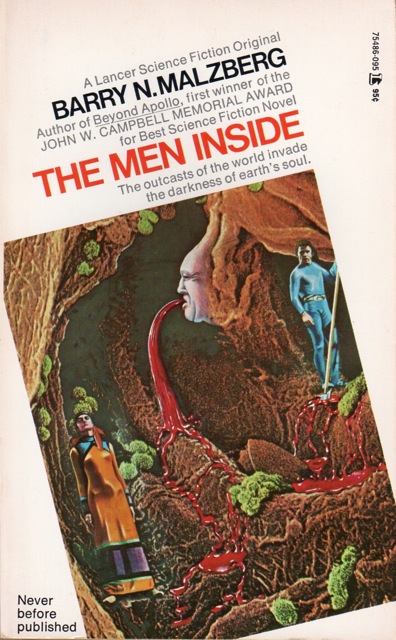
I learned after reading the story that it was expanded into a full novel. Would love to read this, can only imagine how weird it gets.
Reviews and Reception
As noted in my blog post about the short story award nominations of 1973 (awarded to stories from 1972, of course), Eurema’s Dam from New Dimensions II was co-winner of the Hugo Award for Best Short story, while On the Downhill Side and When We Went to See the End of the World both received nominations. Patron of the Arts from Universe 2 was nominated for Best Novelette at both awards. Universe and New Dimensions placed 2nd and 3rd respectively in the Locus Poll for Best Original Anthology, both being beaten by Harlan Ellison’s Again, Dangerous Visions.
There weren’t a lot of reviews of the books to go through (especially because back issues of Locus are basically non-existent online) but I managed to fine a pro and fanzine review each for New Dimensions and a single fanzine review for Universe. It’s looking like this blog post will go up before my examination of Damon Knight’s Orbit series, so this will be my first discussion on the blog of my adventures in reading old book reviews and getting to know the personalities and complaints of various reviewers. The two main reviewers I’ll be discussing today are familiar to me from their reviews of various Orbit volumes, and they both reviewed New Dimensions II. I’ll quickly say the following about the only review of Universe 2 I have access to, Brian Griffin’s review in Vector 75: it was useful for thinking about how these stories would have been viewed differently in their context than they are today, but there wasn’t much meat to chew on.
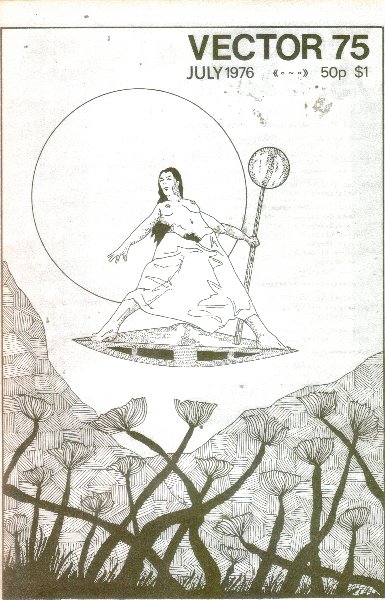
The quality of this scan is abysmal, but adobe's guess at the text (though typo-ridden) made it readable.
Onto the more controversial reviews of New Dimensions II: Nebula winner Alexei Panshin’s professional whining about how he wants things to be like they used to be in his review column for The Magazine of Fantasy and Science Fiction, and Richard E. Geis’s amateur complaining that these new writers make their stories hard to understand for no good reason in his long running (and many times re-named) fanzine, The Alien Critic.
This is the second book review column I’ve read by Alexei Panshin, and both columns have started with him getting up on his soapbox and complaining about people writing the wrong kind of science fiction. He doesn’t like pessimism, he doesn’t like near future stories, and in this column he opens by decrying the increasing divisions in society and the fracturing of formerly mass culture. Obviously, in 1972 all these things were very real and reasonable to be concerned about but looking back from 2026 you can only say “lmao”.
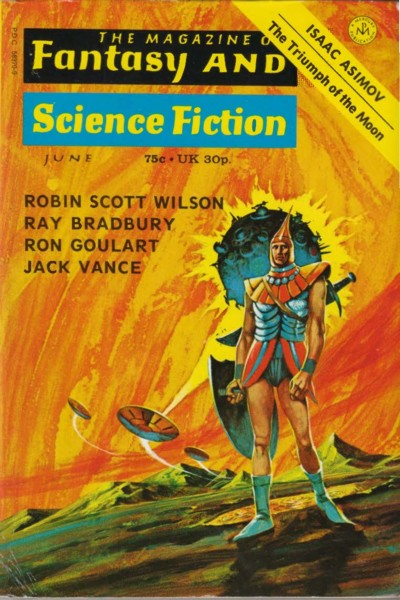
Reading through a lot of F&SF book review columns and going from Judith Merril, one of the great critics of SF, to Alexei Panshin...it's dire
Anyway, he doesn’t like a lot of the stories (unsurprisingly he like the Asimov), and going in I knew he would hate the Dozois, which I also hated, so fair play to him. I find it very difficult to take these kinds of reviews in good faith because they’re so caught up in the contemporary ideological battle over what science fiction is or should be. A lot of the time reviewers taking this approach complain for paragraphs about tone or aesthetic or perspective and then aside from one or two examples they proceed to say the stories are good! You see this to an even greater degree with Geis, who complains and complains about stories being too intellectual (both reviewers complain about Silverberg’s introduction where he declares his intention to raise the calibre of literature in science fiction writing over what has traditionally been published in the pulp magazines) and then he concludes his review by saying “oh yeah and the collection is one of the best and most original things being sold anywhere, I recommend you buy it”. Very funny!
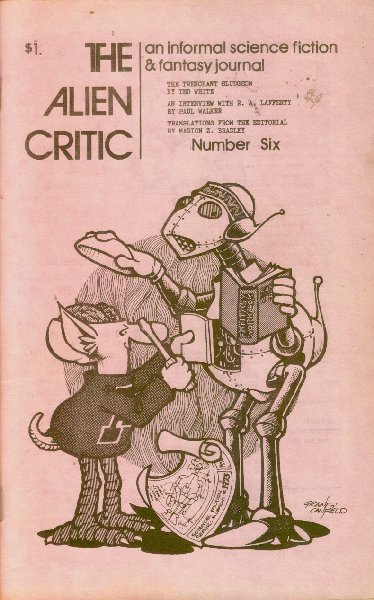
Geis is a fascinating figure in the history of SF fan culture, as he was very influential while also being a grade-A crank. Maybe that makes him a very average figure in the history of any kind of fan culture, but his influence means he needs to be reckoned with in some way.
Conclusion
- On the Downhill Side by Harlan Ellison
- A Special Condition in Summit City by R.A. Lafferty
- The Men Inside by Barry Malzberg
- Nobody’s Home by Joanna Russ
- Filomena & Greg & Rikki-Tikki & Barlow & the Alien by James Tiptree, Jr.
The best story in Universe 2 is probably On the Downhill Side by Ellison, and the best story in New Dimensions II is (in my humble opinion) Malzberg’s The Men Inside.
It’s time now to pick the better of the two collections. Universe 2 has more good stories and fewer bad stories than New Dimensions II. However! The bad stories in New Dimensions II are largely just unintelligible rather than unpleasant, and three of the four are quite short. The one story that is both long and unpleasant (King Harvest) is ultimately well written, its unpleasantness being in the sheer depressive misery that it languishes in. On the other hand, Universe 2 had the absolute most unpleasant single story to read in either collection, and New Dimensions II had more Great stories than Universe 2. It really could go either way. Ultimately I think I just enjoyed New Dimensions II more as a reading experience. It had higher highs, fewer long stories that were either dull or outright bad, and the inclusion of the stylistically distinct Asimov story gives it texture. However, I’ll bet you 20 bucks that Again, Dangerous Visions blows both of these out of the water…maybe I’ll get to that one next.
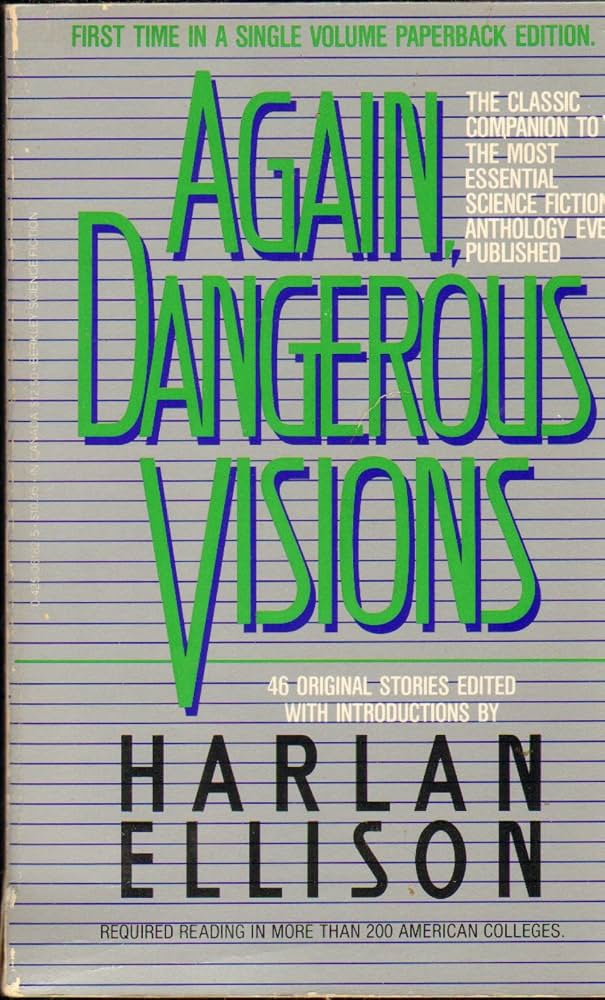
Of course, first I'd have to read Dangerous Visions (the first one)...
Links and Recommendations:
- A Canticle for Leibowitz/The Shelved by Genre Podcast: I just finished re-reading this, part of my effort to catch up on Shelved By Genre which remains my favourite Book/SF podcast, and one of my favourite podcasts overall. The hosts' insights and discussion always get me excited about reading and writing more, both criticism and original fiction. And Canticle? God. Incredible book. Really had mixed feelings about it when I read it at like 18, but I totally loved it this time. Grim though, to be clear.
- Akira: The iconic film has been back in theatres in IMAX over the last couple weeks. You may have missed it by now, so uh, sorry! But damn, what a movie. Keep your eyes out for Ghost in the Shell coming back to theatres this weekend/next week!
Hinterlands #2 is complete! Physical copies are out in the world, and if you don't have one yet, hopefully you will soon. Digital copies will be available in about two weeks, once I've finished giving away the physical ones. I'm hoping to get Hinterlands #3 out physically in October and digitally before the end of November, but that may be overly optimistic. For now, Hinterlands Annual #1 is still available here.
Still working on the next youtube video! The last one is still here if you haven't seen it yet.
Okay bye!