Fun with Graphs
So after my 10 page short fiction extravaganza last week, I had one goal for this week’s blog post: take it easy. I wasn’t going to burn myself out editing mega-posts in back to back weeks. So, I came up with the idea of graphing the magazines and anthologies where award nominated short stories were originally published. This seemed like a natural follow-up to last week’s post because it provides additional context and functions as a bit of a historical analysis. I could lean on the graphs alongside maybe some photos of my vintage anthologies and collections and keep the writing down to a page or two total.
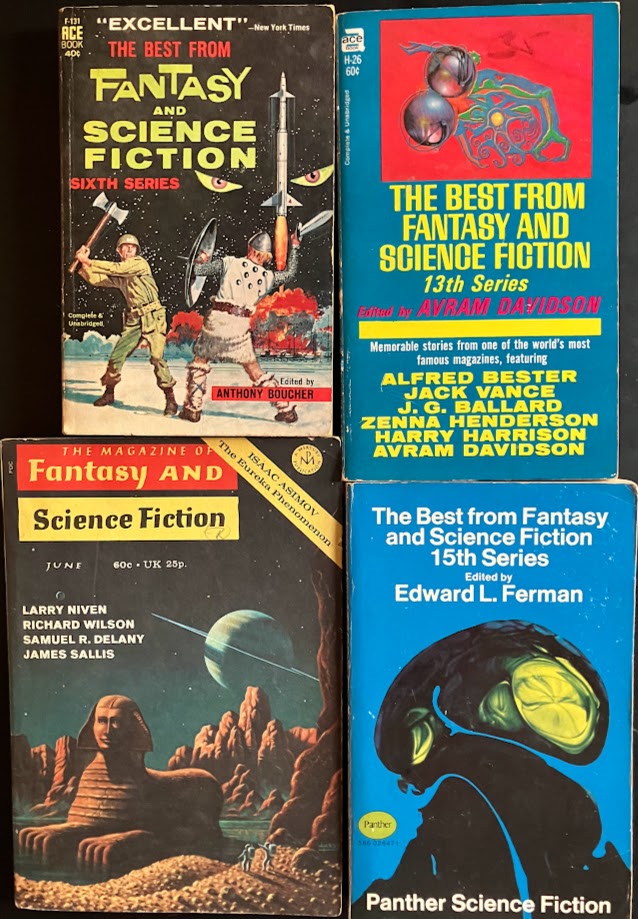
Those three anthologies have wildly different styles in terms of layout and art, but I love all three. Finding something like this is like striking gold to me at a used bookstore or thrift store.
This has all borne out! The plan was followed to a T! However! It turns out that gathering the required data, i.e. writing in a spreadsheet every hugo and nebula nominated short story and what magazine they were published in, is actually a lot of work! And then processing that data so you can make a useable graph out of it, is a lot of work! And then manually adding a bunch of graphics and labels to that graph is a lot of work! So that ultimately this blog post was a lot more work than most, and maybe even just as much work as the 10 page behemoth from last week. But hey, at least I didn’t write very much.
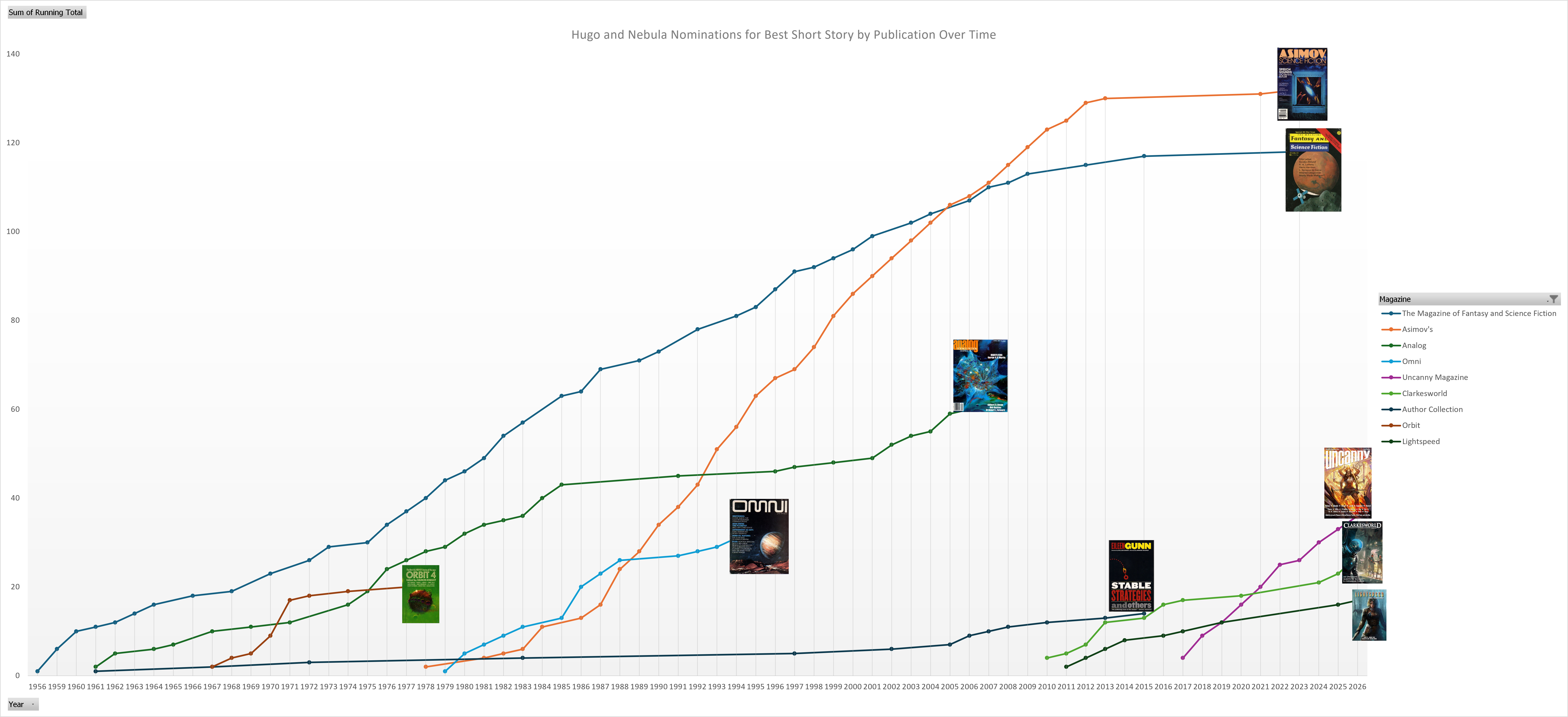
You're going to want to open this image in a new tab to really read it. This graph combines the totals for the Hugos and Nebulas and displays only the top 10 publications by cumulative nominations.
With the pre-amble out of the way, let’s get to the fun part: looking at graphs. There are a few interesting trends that jumped out at me. The awards have historically been dominated by a handful of major magazines, particularly The Magazine of Fantasy and Science Fiction and Asimov’s Science Fiction, and to a lesser extent Analog and Omni. Orbit is there at the back as the most successful representative of the golden age of the serialized original anthology, which New Dimensions, Dangerous Visions, Universe, and others were a part.
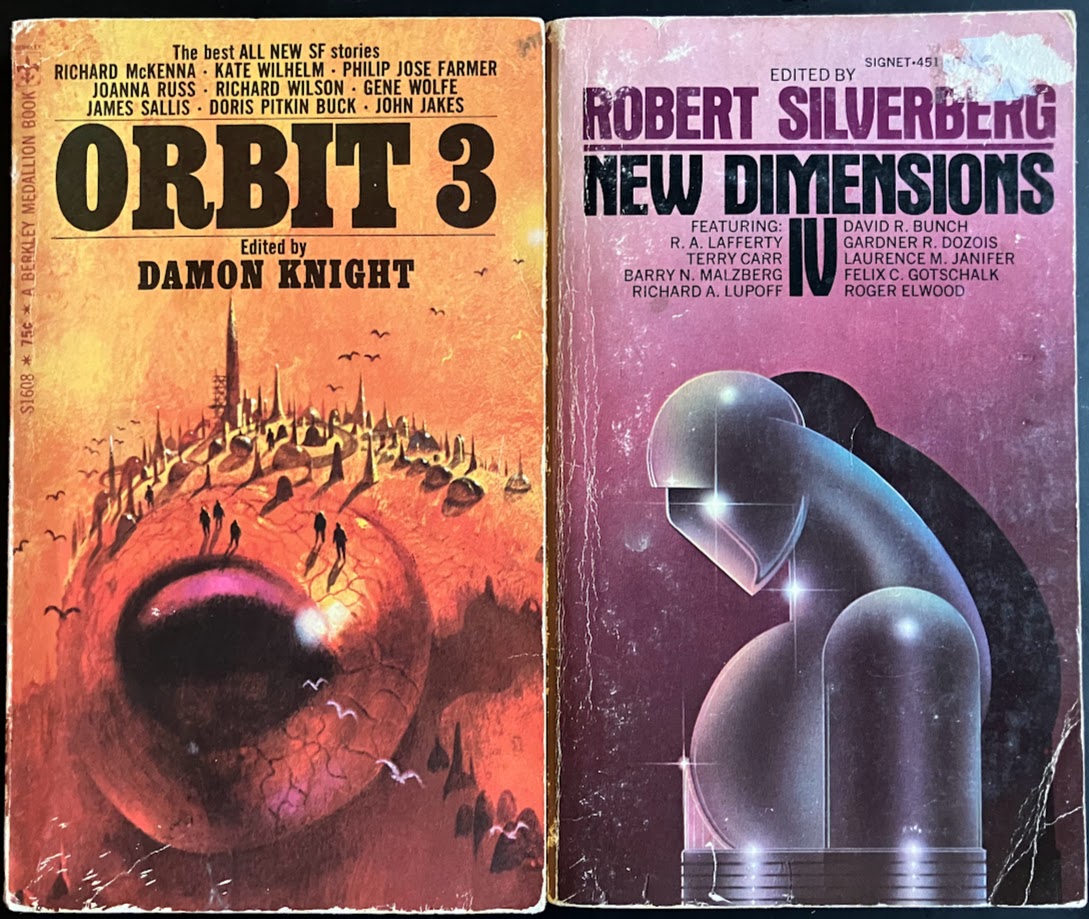
Long term I'm definitely going to need to learn more and write about Orbit - while being hugely controversial in their day, they seem to have been some of the most important and prescient original anthologies every printed.
In the last ten to fifteen years there’s been a significant changing of the guard as the traditional magazines have been replaced in the awards game by digital magazines like Uncanny, Clarkesworld, and Lightspeed. We can speculate on reasons for this, although the accessibility of digital and the balancing out of pay rates between digital and print as print viability continues to erode likely play a large role. Additionally, the fallout from the hijacking of the 2015/16 Hugo awards by reactionary fans leading to the re-calibration of the rules may have led to a change in the Hugo voter makeup shifting towards younger fans who are more likely to read online and value the prestige of traditional major magazines less. This is all speculation though. (Note that because of Hugo voting scandals putting into question the validity of the nominees, Hugo nominees from 2015/2016/2023 have been excluded from the dataset).
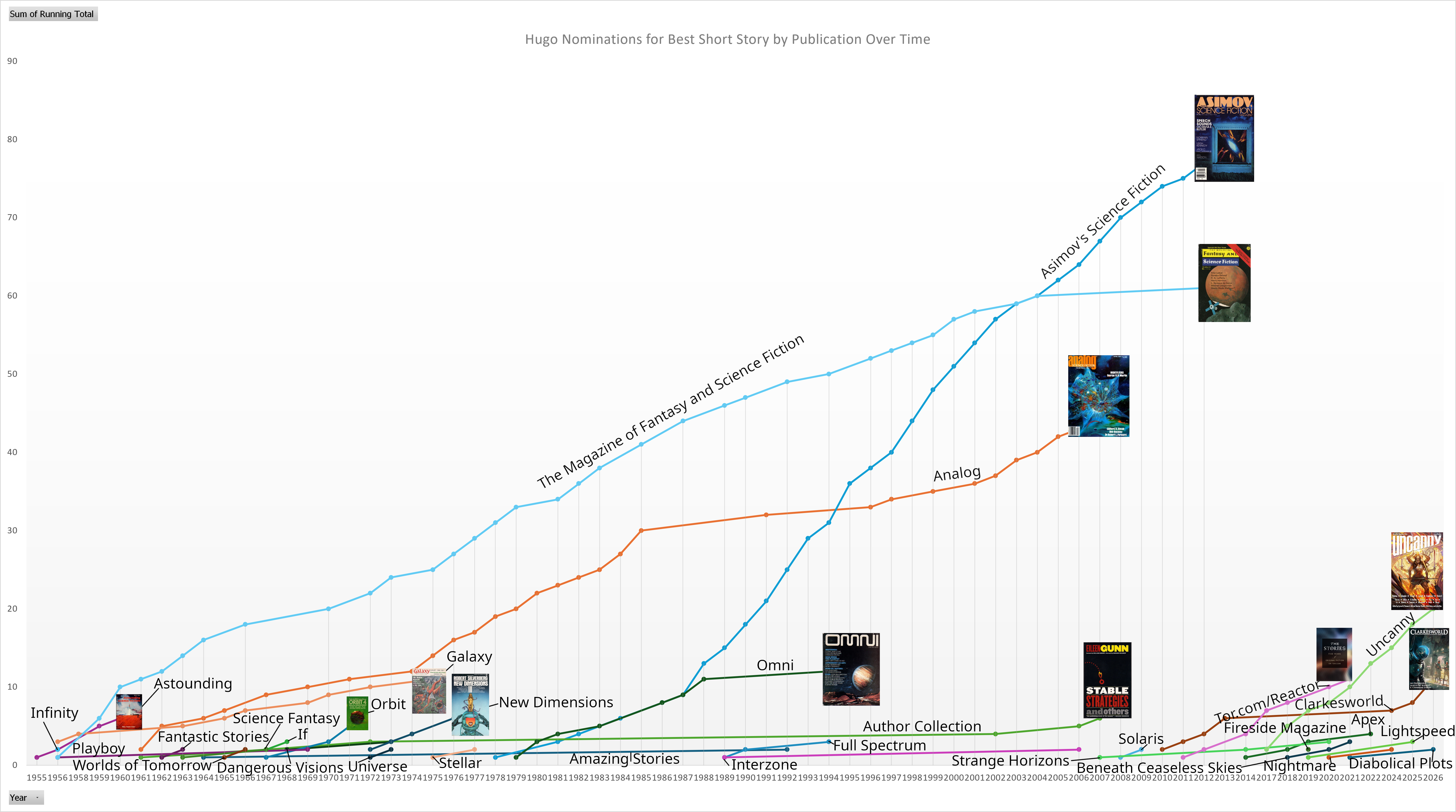
You're going to want to open this image in a new tab to really read it. This graph contains just Hugo nominations, and as noted above, 2015/2016/2023 nominations are excluded due to The Reasons.
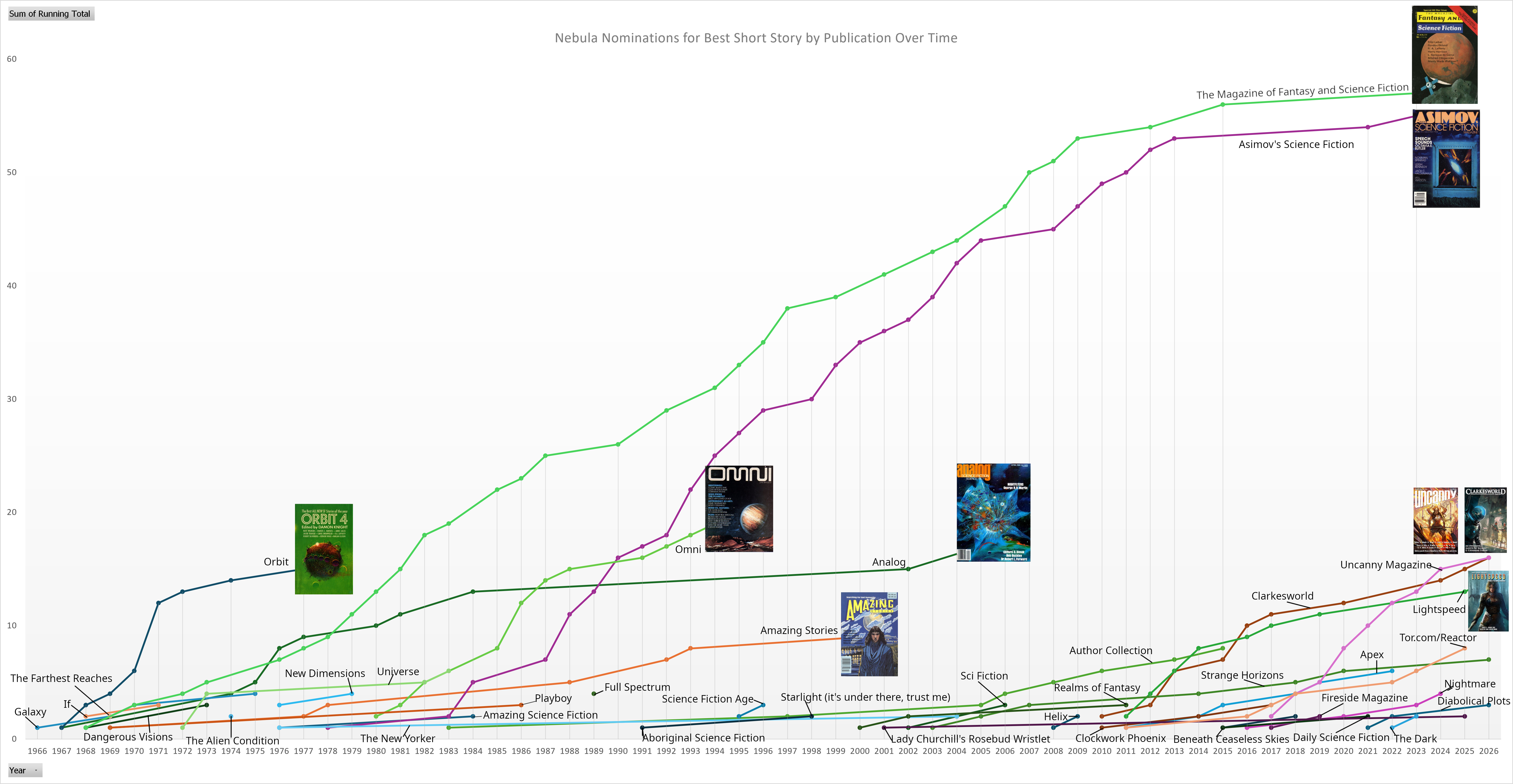
You're going to want to open this image in a new tab to really read it. This graph contains just Nebula nominations.
Looking at the Hugo and Nebula breakdowns, it leaps off the page that Hugo voters are simply reading (or at least voting) less broadly than Nebula voters. This makes sense, because the Nebulas are voted on by professional authors who are more likely to be comped copies of relevant stories, magazines, etc during the nomination period rather than just the actual nominees before the final round of voting, which is what (I assume) is in the packets Hugo voters receive. Lets be real, while I don’t want to put authors on a pedestal, I think it’s fair to say they have more time, resources, and knowledge than fans when it comes to judging a wide range of fiction for awards. While there are certainly dedicated fans who could put most authors to shame, there probably aren’t enough of that kind of fan to overpower the mass who are likely reading one or two publicaitons max, especially in the pre-internet era where you had to be subscribing to any magazines you want to read. In the 80’s, the public library probably wasn’t carrying Interzone. So it’s a point in favour of the Nebulas, which historically nominate stories from a much broader set of publications, whereas the Hugos went “My Best Friend is The Magazine of Fantasy and Science Fiction. Now my best friend is Asimov’s Science Fiction. Now my best friend is Uncanny Magazine.”
Anyway. This blog post was mostly supposed to be the graphs, so I’ll leave it at that for now. I hope you enjoy looking at them, and I hope it inspires you to learn more about some of these publications. The editors of these magazines had enormous influence on shaping what science fiction is today, for better and worse, so it’s good to know about them!
One final note: while doing the tedious data entry to build these graphs, I noticed a handful of stories that were nominated for an award (usually the nebula) that have never been reprinted. It’s possible these represent incompleteness on the part of the Internet Speculative Fiction Database, but I’m interested in finding out more about these stories. As long as they aren’t terrible, maybe there’s a way of digging up the rights and publishing an anthology of them. A long term goal of mine is to edit some anthologies one way or another, and this could be a fun way to get started (although as they aren’t in the public domain it immediately becomes complicated – how could I get a project like this off the ground? How could I sell a book to people? I can barely give away a free zine.) That’s a problem for another day.
Links and Recommendations:
I want to recommend the anthology of Chinese Short SF in translation, Invisible Planets, again now that I've finished it - I think it's very strong and it's becoming clear that to be a dedicated reader of Science Fiction in the modern era requires knowing at least a little bit about Chinese SF. I quite liked the essays at the end - Cixin Liu takes a very funny shot at Robert J. Sawyer, which is completely deserved from what I can tell, but at the same time I don't want to give Cixin Liu any props because any time I read his fiction my eyes roll out of the back of my head (even though it's often good! I like both of his stories in this collection!). I finally read The Dark Forest this year after loving Three Body Problem when I read it in my early 20s, and I liked parts of it but found the overall tone and perspective on human beings (and aliens) to be unconvincing. Guy writes like an engineer. I don't like to write about modern SF that I dislike, but maybe figuring out how to do so in a way I'm happy with is important for my development as a writer. I'll probably read Death's End at some point and then maybe I can do a deep dive blog post where I can explore my feelings on Cixin Liu, although I'm held back by the fact that only so much of his work is available in English. ANYWAY - Cixin Liu is only a very small part of Invisible Planets, and other writers like Chen Qiufan and Xia Jia outshine him (in my opinion).
Thanks for reading! Physical Annual Zines were mailed out like a month ago now, so hopefully they've all arrived. It will go up digitally THIS WEEKEND (July 18/19). In the meantime you can STILL get Hinterlands #1, here.
My new Youtube video...IS HERE!
Okay bye!